Communicative competence of future doctors: From theoretical approaches to educational solutions
DOI:
https://doi.org/10.33910/herzenpsyconf-2025-8-97Keywords:
development, communicative competence, psychological and pedagogical conditions, active learning methods, standardized patient, systemic-anthropological approachAbstract
The article addresses the development of communicative competence in future doctors as a key component of their professional training. It emphasizes that the ability to establish effective interaction with patients of different age groups and their relatives requires well-developed skills in empathy, active listening, information adaptation, and emotional self-regulation. An analysis of Russian and international research reveals a lack of unified approach to the systematic development of communicative competence in medical universities. Nevertheless, researchers consistently highlight this aspect as critically important for a physician’s professional practice. The purpose of the article is to delineate the structure, content, and implementation characteristics of the program, alongside an analysis of its efficacy derived from independent expert assessment. Based on systemic-anthropological, activity-based, competency-based, and systems approaches, a training program has been developed for fostering communicative competence in future doctors. The program includes 8 modules with a total duration of 72 hours. It is founded on the principles of systemic learning, learning through action and experience, reflective learning, and value-semantic orientation. Training combines traditional and innovative methods, including role-playing, clinical case analysis, the ‘standardized patient’ technique, group discussions, and reflective journaling. Particular emphasis is placed on integrating students’ personal and professional experiences, which enhances motivation and the practical applicability of the acquired knowledge and skills. Special attention is given to ethically significant aspects of medical communication, such as delivering bad news, interacting with vulnerable patient groups, and maintaining professional boundaries. The program aims not only to develop specific communication skills but also to form holistic professional identity for a physician capable of partnership-based interaction, critical thinking, and assuming responsibility for communication outcomes. An independent expert evaluation confirmed the program’s high practical relevance, adaptability, and alignment with contemporary healthcare challenges. The results indicate that the program can serve as a universal model for implementation in medical universities and on continuing professional education programs.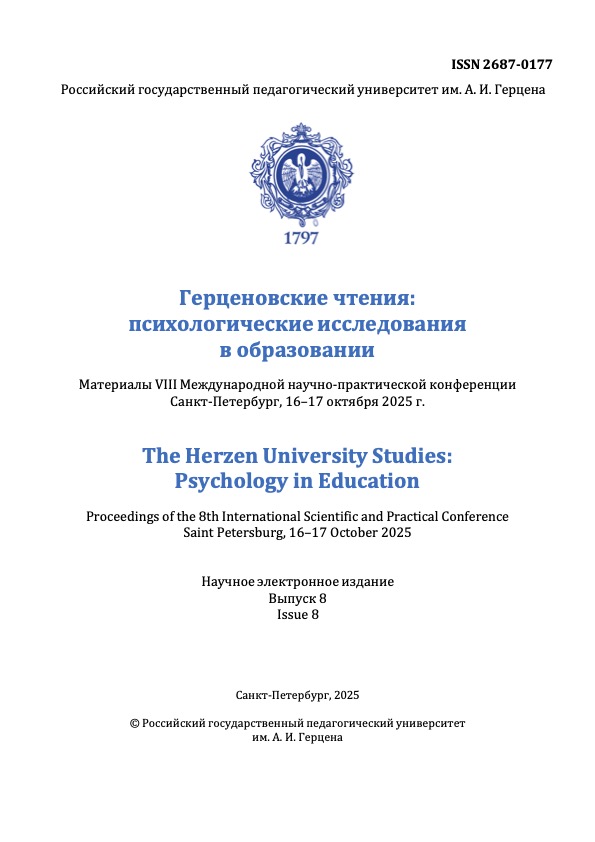
Downloads
Published
2026-02-20
Issue
Section
Статьи
How to Cite
Turova, I.V. (2026) “Communicative competence of future doctors: From theoretical approaches to educational solutions”, Герценовские чтения: психологические исследования в образовании, pp. 757–765. doi:10.33910/herzenpsyconf-2025-8-97.